

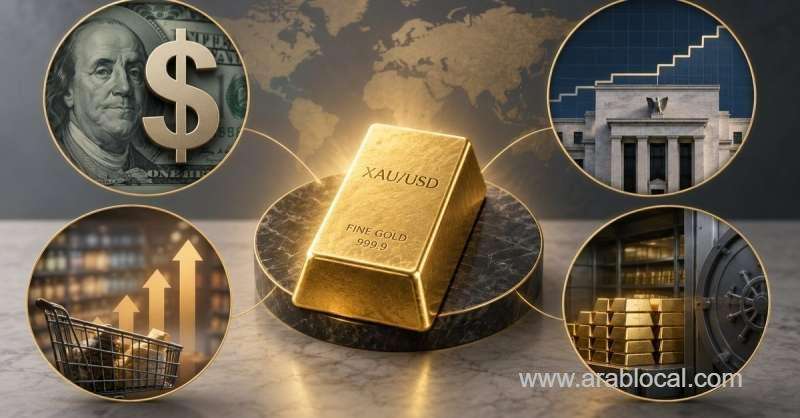
In Qatar, gold is never just a number on a screen. It is a wedding gift, a family heirloom and, for many households, a way of putting savings somewhere safe. Yet anyone who has walked through the gold shops of Doha knows the price board can look different from one week to the next, sometimes from one day to the next. This guide explains, in plain language, what actually moves the price of gold, what the market symbol XAU/USD means, and how a change on global markets finds its way to the price you pay per gram in Qatari riyals.
What XAU/USD Actually Means
Reading the gold ticker
XAU/USD is the standard market symbol for the price of one troy ounce of gold quoted in US dollars. "XAU" is the international code for gold, and "USD" is the US dollar. When you see XAU/USD at 4,250, it means one troy ounce of gold costs US$4,250 on the global wholesale market.
Because the price is a ratio between gold and the dollar, it can rise for two different reasons: gold itself becomes more valuable, or the dollar becomes weaker. Often it is a mix of both. Keeping this in mind makes many daily price moves much easier to understand.
From ounce to gram: how the global price becomes a Doha shop price
Gold shops in Qatar quote prices per gram, not per ounce. One troy ounce equals 31.1035 grams, so converting the global price is simple arithmetic: multiply the XAU/USD price by 3.64 (the riyal's fixed exchange rate) and divide by 31.1035. For example, if gold is trading at US$4,250 an ounce, pure gold works out to roughly QAR 497 per gram before any shop charges are added.
Why Gold Prices in Qatar Follow the Global Market
The riyal's fixed peg to the US dollar
The Qatari riyal has been pegged to the US dollar at 3.64 riyals per dollar for decades. This is a big advantage for gold buyers in Qatar: there is no exchange-rate swing to worry about. When XAU/USD rises 1%, the riyal price of gold rises by almost exactly 1% too. In countries with floating currencies, a weak local currency can push gold prices up even when the global price is flat, but that effect is largely absent in Qatar.
Making charges and retail premiums
The price on a jeweller's board is the gold value plus a making charge for design and craftsmanship, and sometimes a small premium for the shop. Plain bars and coins usually carry low premiums, while intricate jewellery can carry much higher making charges. That is why two pieces of the same weight and karat can have noticeably different prices, even though both move with the same global market.
Purity also matters. Most gold sold in Qatar falls into one of four karat grades:
| Karat | Gold purity | Common use in Qatar | Approx. QAR per gram at US$4,250/oz (before making charges) |
|---|---|---|---|
| 24K | 99.9% | Bars, coins, investment gold | ~497 |
| 22K | 91.6% | Traditional Gulf and Indian-style jewellery | ~456 |
| 21K | 87.5% | Popular Arabic jewellery designs | ~435 |
| 18K | 75.0% | Modern, diamond-set and everyday pieces | ~373 |
Lower karats contain less pure gold, so they cost less per gram, but they are also harder and more durable, which is why they are popular for everyday wear.
The US Dollar: Gold's Biggest Opposite
Because gold is priced in dollars, the strength of the dollar has a direct effect on it. When the dollar strengthens against other major currencies, gold becomes more expensive for buyers in Europe, India, China and elsewhere, which tends to reduce demand and pull the price down. When the dollar weakens, the opposite usually happens and gold tends to rise.
Traders often watch the US Dollar Index (DXY), which measures the dollar against a basket of major currencies. It is not a perfect mirror image of gold, but over most periods the two move in opposite directions. For readers in Qatar, this is worth remembering: even though the riyal itself is fixed to the dollar, the dollar's strength against the euro, yen or yuan still shapes the global gold price you end up paying.
Interest Rates, Real Yields and the Federal Reserve
Opportunity cost explained simply
Gold does not pay interest or dividends. A bar sitting in a safe earns nothing, while cash in a deposit account or a US Treasury bond does. When interest rates rise, holding gold means giving up more income elsewhere. Economists call this the opportunity cost of holding gold.
What matters most is the real yield, meaning the interest rate after inflation is subtracted. If a bond pays 4% but inflation runs at 4%, the real return is zero, and gold looks relatively attractive. If the same bond pays 4% while inflation is just 2%, the real return is a healthy 2%, and gold faces more competition. This is why gold investors pay such close attention to the US Federal Reserve, which sets the benchmark US interest rate.
Case study: the September 2026 Fed rate hike
A clear recent example came on 16 September 2026, when the Federal Reserve raised its benchmark rate by a quarter of a percentage point to a range of 3.75% to 4.00%, its first increase since 2023. Officials also signalled that rates could go higher before the end of the year, citing inflation that remains well above their 2% target. The dollar firmed and gold fell from around US$4,350 to below US$4,250 an ounce on the day, a move of more than 2%.
The reaction was textbook, but it is not a fixed rule. Gold can rise even when rates go up, for example if markets fear that higher rates will slow the economy or trigger financial stress. Gold had also already pulled back from the record highs it reached in January 2026, so the Fed decision added to an existing trend rather than starting a new one.
Inflation and Gold's Role as a Store of Value
For thousands of years, gold has been used to protect purchasing power. When the cost of everyday goods rises faster than wages or savings, many people turn to gold because its supply grows only slowly and cannot be printed like paper money.
In practice, the link between inflation and gold is strongest when inflation is rising faster than interest rates. If central banks respond to inflation by raising rates aggressively, the higher real yields can offset gold's appeal. That is why gold sometimes rallies when inflation first appears, then stalls when central banks begin to act. Watching both numbers together gives a much clearer picture than watching either one alone.
Who Is Buying? Central Banks, Investors and Jewellers
Every gold price is ultimately set by supply and demand. Mine production changes slowly, so most of the action comes from the demand side, and there are three very different groups of buyers.
Record central bank demand
Central banks have become one of the most powerful forces in the gold market. According to the World Gold Council, central banks and other official institutions bought a net 289 tonnes of gold in the second quarter of 2026, up 62% from a year earlier and the strongest second quarter on record. Poland was the largest buyer with 51 tonnes, followed by China with 33 tonnes.
Many countries are adding gold to diversify their reserves away from any single currency. In the World Gold Council's latest survey of central banks, a record 45% said they plan to increase their own gold holdings over the next 12 months. This kind of steady, long-term buying tends to support prices over months and years rather than days.
ETFs and investors
Investors buy gold through bars and coins, and through exchange-traded funds (ETFs) that hold physical gold on their behalf. This group reacts quickly to interest rates and market sentiment. In the second quarter of 2026, global gold ETFs saw net outflows of about 45 tonnes, led by North American funds, while demand for bars and coins held roughly steady at 307 tonnes. Over the first half of the year, total gold demand reached about 2,522 tonnes, worth a record US$380 billion.
Jewellery buyers in Qatar and the Gulf
Jewellery is the most price-sensitive part of the market. When prices climb sharply, many buyers wait, trade in old pieces or choose lighter designs. Global jewellery demand fell 17% in the second quarter of 2026 as high prices weighed on shoppers, especially in China and India. In Qatar and across the Gulf, jewellery buying often picks up around weddings, Eid and other celebrations, and around price dips, when buyers see better value.
Geopolitics and Safe-Haven Demand
Gold is widely seen as a safe haven, an asset people turn to when they feel uncertain. Wars, trade disputes, sanctions, banking stress and elections can all push investors and central banks towards gold. These moves can be sudden: a single headline can lift prices within minutes, and the gains can fade just as quickly if the situation calms.
For long-term buyers, it helps to separate these short spikes from the slower forces of interest rates and central bank demand. Safe-haven buying explains many of gold's sharpest daily moves, but it rarely sets the direction for the whole year on its own.
A Simple Checklist for Tracking Gold Prices in Qatar
You do not need a professional trading screen to follow the gold market. A short checklist covers most of what matters:
- Federal Reserve meetings: the next decision is due on 27–28 October 2026, and rate changes or guidance often move gold sharply.
- US inflation and jobs data: monthly consumer price and employment reports shape expectations for future interest rates.
- The US Dollar Index: a stronger dollar usually weighs on gold, a weaker one usually supports it.
- World Gold Council quarterly reports: these show what central banks, investors and jewellery buyers are actually doing.
- Geopolitical headlines: major global events can trigger sudden safe-haven buying.
- Local shop prices: compare per-gram rates and making charges across several jewellers in Doha before buying.
Frequently Asked Questions
Why can gold be cheaper or more expensive in Qatar than in other countries?
The underlying gold value is almost identical worldwide, because it is based on the same global XAU/USD price. Differences come mainly from local taxes, import duties, making charges and retail competition. Because the riyal is fixed to the dollar and Doha's gold market is highly competitive, Qatari prices tend to stay close to the global benchmark plus making charges.
Does the riyal's peg protect buyers from exchange-rate swings?
Yes, against the dollar. Because the riyal is fixed at 3.64 per dollar, buyers in Qatar do not face the extra currency risk seen in countries with floating exchange rates. However, the peg does not protect against changes in the global gold price itself, which still rises and falls with the dollar, interest rates and demand.
Is now a good time to buy gold in Qatar?
No one can reliably predict short-term gold prices, and the right decision depends on your goals, budget and time horizon. Buyers purchasing jewellery for a wedding or gift often focus on design and making charges, while those buying for savings tend to prefer low-premium bars or coins and spread purchases over time. For investment decisions, it is best to speak to a licensed financial adviser.
The Bottom Line
Gold prices can look random from day to day, but most moves come back to a handful of forces: the US dollar, real interest rates, inflation, demand from central banks, investors and jewellers, and global headlines. Once you understand how these pieces fit together, XAU/USD stops being a mystery and becomes a scoreboard you can read. And thanks to the riyal's fixed peg, that scoreboard translates directly into the price per gram in Qatar.
Gold prices can move sharply around central bank decisions and economic data releases, and trading gold with leverage carries a high level of risk. Past price movements do not guarantee future results. This article is for general information only and is not financial advice.